
When selecting thermal management solutions for modern processors, power electronics, or high-performance systems, thermal engineers and system builders often face a balancing act.
While extreme cooling methods like liquid nitrogen, dry ice, or complex liquid cooling loops deliver outstanding thermal dissipation, their operational complexity, leakage risks, and high cost make them impractical for standard industrial or commercial applications. On the other hand, traditional pure-metal air coolers often hit thermal limits under heavy, sustained workloads.
Tubed heat sink technology bridges this gap perfectly. By combining phase-change thermodynamics with high-surface-area fin arrays, tubed heat sinks deliver exceptional heat dissipation efficiency, design flexibility, and long-term reliability.
In this guide, Xuyuan Precision breaks down the working principles, capillary wick structures, pipe sizing metrics, and critical selection parameters for tubed heat sinks.
1. How Tubed Heat Pipe Systems Work
At its core, a heat pipe is a closed, two-phase heat transfer system. It moves thermal energy across distances with extremely low thermal resistance by utilizing the continuous evaporation and condensation of an internal working fluid sealed inside a vacuum copper tube.
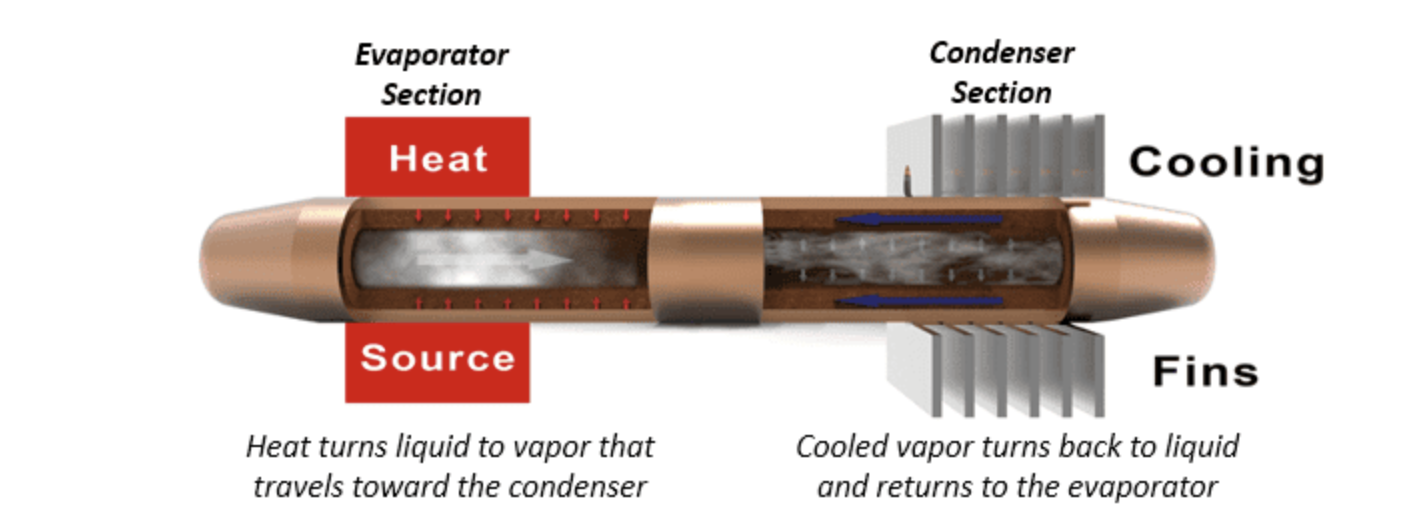
The 4-Step Thermal Cycle:
What Is Inside a Heat Pipe?
A standard heat pipe consists of three core components:
Fluid Charging Precision
The amount of working fluid injected into the pipe must be calculated with extreme precision:
Example: A standard copper heat pipe with a 5mm Outer Diameter (OD), 3.6mm Inner Diameter (ID), and 150mm Length requires an exact liquid fill volume of 0.4 mL.
2. Core Technology: Capillary Wick Structures Compared
The capillary wick structure is the most critical element of a heat pipe. It performs three vital functions:
While four basic wick types exist (wire mesh, grooved, sintered powder, and fiber), the PC and industrial electronics markets rely heavily on Grooved and Sintered Powder structures.
| Technical Parameter / Feature | Grooved Heat Pipe | Sintered Powder Heat Pipe |
|---|---|---|
| Manufacturing Method | Single-step mechanical extrusion | High-temperature copper powder sintering |
| Relative Production Cost | ~66% of Sintered (~1/3 cheaper) | Higher (requires pure copper powder & precise temperature control) |
| Capillary Force | Moderate | Very High |
| Orientation Sensitivity | High (Fails or loses efficiency when bent severely or operated against gravity) | Low (Operates reliably at any angle or installation direction) |
| Ideal Application | Straight runs, cost-sensitive consumer products | High-performance CPU/GPU coolers, complex custom bends, industrial gear |
At Xuyuan Precision, we specialize in precision-sintered heat pipe assemblies, ensuring consistent thermal dissipation regardless of installation orientation or structural bending.
3. Heat Pipe Diameter vs. Thermal Resistance & Heat Capacity
Heat pipe diameter directly influences thermal throughput and resistance. Based on empirical testing (150mm length tested across a 60°C – 90°C range), larger pipe diameters significantly lower thermal resistance (Rth) and dramatically increase maximum heat transfer capacity (Qmax).
| Heat Pipe Outer Diameter | Thermal Resistance (Rth) | Max Heat Transport (Qmax) | Heat Transfer Cycle Speed |
|---|---|---|---|
| 3 mm | 0.33 °C/W | 15 W (15 Joules/sec) | 15W per 2.8 cycles |
| 5 mm | 0.11 °C/W | 45 W (3x capacity vs 3mm) | 45W per 1.8 cycles |
| 8 mm | 0.0625 °C/W | 80 W (5.3x capacity vs 3mm) | 80W per 0.6 cycles |
Key Takeaways:
4. Key Considerations When Buying or Designing Tubed Heat Sinks
When designing or sourcing tubed heat sinks for your application, keep these critical factors in mind:
Partner with Xuyuan Precision for Custom Thermal Solutions
Whether you need high-efficiency sintered heat pipe assemblies, custom CNC-machined copper bases, or fully integrated tubed heat sink units, Xuyuan Precision offers end-to-end engineering support, prototyping, and mass production.
Need tailored thermal engineering advice for your next project?
Post time: Aug-22-2026


