
As high-power electronic devices continue to push the boundaries of performance, traditional air cooling is rapidly reaching its physical limits. For engineering and procurement teams, the transition to liquid cooling is no longer optional—it is a necessity. However, sourcing a custom liquid cold plate is vastly different from purchasing standard off-the-shelf components like screws or simple heat sinks.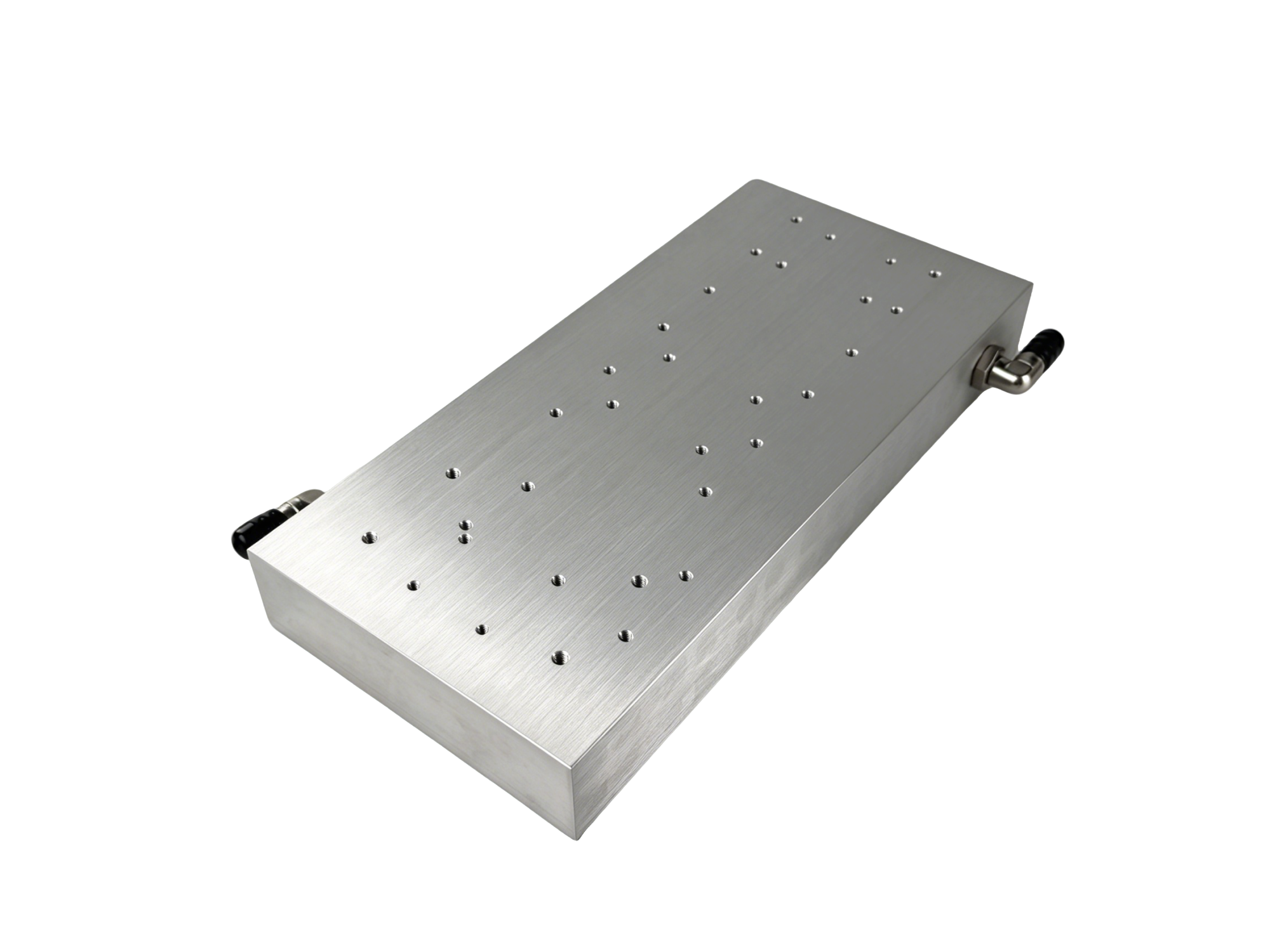
Many buyers fall into the trap of focusing solely on unit price or basic dimensional specifications. In reality, a liquid cold plate is a highly customized, safety-critical thermal management component. The manufacturing process, internal fluid routing, material selection, and the supplier’s engineering capabilities will fundamentally determine the cooling efficiency and operational lifespan of your entire system.
When your equipment must endure continuous coolant circulation, thermal cycling, and high heat loads, choosing the right liquid cold plate supplier means choosing a long-term thermal solution. To help you navigate this critical procurement process, here are seven essential questions you must ask your supplier before making a decision.
1. Does the Cold Plate Match Your Specific Thermal Requirements?
Every thermal management project begins with heat. The primary objective of any custom liquid cooling plate is to minimize thermal resistance and maximize heat dissipation efficiency. However, simply knowing the total wattage of your system is not enough.
Before committing to a design, you must ensure the supplier can precisely match your specific thermal parameters. This includes analyzing:
-
Heat flux density (localized hotspots)
-
Required coolant flow rate
-
Allowable pressure drop limits
-
Temperature uniformity across the component surface
A reliable liquid cooling solution supplier will not just accept a basic drawing; they will offer active engineering support. At Xuyuan Precision, we utilize advanced Computational Fluid Dynamics (CFD) and Finite Element Analysis (FEA) to simulate how heat transfers from your device into the cooling fluid. By identifying potential thermal bottlenecks early, we adjust the liquid cold plate design to ensure it maintains stable junction temperatures under continuous high loads.
2. Can the Supplier Provide Custom Internal Channel Design?
Once thermal requirements are established, the next logical step is determining how the cold plate will absorb that heat. The secret to a high-performance liquid cold plate lies almost entirely in its internal channel geometry.
Performance is dictated by the path the coolant takes. An inexperienced supplier might offer basic, straight channels to save manufacturing costs. However, high heat density devices require complex, optimized flow paths. You must ask if the supplier can customize:
-
Channel shapes and dimensions
-
Internal fin densities (e.g., skived micro-fins)
-
Inlet and outlet port positioning
-
Flow distribution networks targeting specific thermal hotspots
Industry Example: In High-Performance Computing (HPC) and AI servers, localized hotspots are a major challenge. Internal channels must be micro-engineered to force coolant directly over high-wattage processors while keeping pressure drop within acceptable limits. A supplier capable of customizing these micro-channels ensures maximum heat transfer efficiency where it matters most.
3. Which Manufacturing Process Is Suitable for Your Application?
If the internal channel design is complex, the next question must address how the supplier plans to physically build it. The manufacturing process you choose dictates the channel geometries possible, structural integrity, and overall unit cost.
Two of the most effective and widely used joining technologies in modern liquid cooling are Vacuum Furnace Brazing and Friction Stir Welding (FSW).
-
Vacuum Brazing: Bonds metal parts in a high-temperature vacuum furnace without corrosive fluxes. It allows for highly complex, intricate internal micro-channels and high-density fin structures. Vacuum brazing is ideal for high heat-flux applications where thermal resistance must be kept to an absolute minimum.
-
Friction Stir Welding (FSW): A solid-state joining process that uses mechanical friction to fuse metals together without melting them. It provides exceptional mechanical strength and zero-porosity joints, making it superior for large-format cooling structures.
Vacuum Brazing vs. FSW for Custom Cold Plates
| Feature | Vacuum Brazed Liquid Cold Plate | FSW Liquid Cold Plate |
|---|---|---|
| Joining Method | Metallurgical bonding in a vacuum furnace | Solid-state mechanical friction |
| Internal Channel Complexity | Very High (Supports intricate micro-channels) | Moderate (Ideal for regular flow routing) |
| Design Freedom | Excellent for compact, high heat-flux zones | Superior for large, structural flat plates |
| Structural Strength | High reliability, uniform metallurgical seal | Exceptional mechanical strength |
| Typical Applications | HPC / AI servers, Laser equipment, Power Electronics | EV battery packs, Industrial equipment, Inverters |
At Xuyuan Precision, we provide both vacuum brazing and FSW manufacturing capabilities in-house, enabling engineering teams to select the exact process that balances their thermal performance needs with structural and budgetary requirements.
4. What Materials Are Available for Your Cooling Plate?
The manufacturing process is deeply tied to the base metal being used. Material selection affects thermal conductivity, overall structural weight, environmental corrosion resistance, and unit cost. You must ask your manufacturer which materials they can reliably process and finish.
The most common materials utilized in liquid cooling include:
-
Aluminum (e.g., 6061 / 6063): Lightweight, cost-effective, and highly machinable. Aluminum is the industry standard for automotive and industrial electronics where system weight and cost are significant considerations.
-
Copper (e.g., C11000): Offering nearly double the thermal conductivity of aluminum, copper is mandatory for extreme heat flux applications requiring rapid thermal spreading, such as high-density AI accelerators or laser diodes.
-
Stainless Steel: Specified primarily when the circulating coolant is highly aggressive or when operating in harsh environmental conditions where aluminum or copper would degrade.
A capable OEM partner like Xuyuan Precision will guide you in selecting the right material not only for thermal conductivity, but also for long-term coolant compatibility and structural requirements.
5. How Does the Manufacturer Control Leakage Risk?
Once materials and internal channels are selected, you must address the single biggest risk in liquid cooling: coolant leakage. When conductive or water-based liquids circulate adjacent to high-voltage electronics, a compromised seal can cause catastrophic system failure.
You must ask the supplier detailed questions about their sealing technology and quality assurance protocols: How do they guarantee the cold plate will not leak after thousands of thermal expansion and contraction cycles?
Quality Standard: A high-quality vacuum brazed or FSW cold plate inherently reduces leak risks because the metallurgical bond creates a unified structure rather than relying on temporary mechanical gaskets.
Furthermore, a professional manufacturer must execute a strict testing pipeline. At Xuyuan Precision, every unit undergoes rigorous validation, including:
-
100% Pressure Decay Testing
-
High-Pressure Burst Testing
-
Helium Mass Spectrometer Leak Detection
-
Thermal Cycling & Shock Validation
6. Can They Support Your Project from Prototype to Mass Production?
Passing a leak test on a single prototype is an important milestone, but the true challenge for procurement and supply chain teams is scale. Can the supplier produce 10,000 units with the exact same quality and dimensional precision as the first sample?
A top-tier supplier does more than just machine parts—they provide end-to-end engineering support:
-
Design for Manufacturability (DFM): Providing early DFM feedback during prototype development prevents costly production delays down the line.
-
In-House Multi-Axis CNC Machining: Ensures tight tolerances and repeatability across high volumes.
-
Supply Chain & Batch Consistency: Controlled furnace schedules and automated welding parameters guarantee uniform quality across high-volume production runs.
Xuyuan Precision supports clients through the entire product lifecycle—from initial CFD thermal design and rapid prototype verification to stable, high-volume mass production.
7. Does the Supplier Understand Your Industry’s Unique Challenges?
Finally, the success of your custom liquid cold plate heavily depends on whether the supplier understands the operational demands of your specific industry. A cold plate installed in a stationary data center behaves very differently from one mounted in a commercial vehicle.
Consider these industry-specific requirements:
-
New Energy Vehicles (EV Batteries): EV battery liquid cooling plates must cover large surface areas, maintain strict temperature uniformity to prevent battery degradation, and withstand constant road vibration and mechanical shock without leaking.
-
High-Performance Computing (HPC & AI): AI servers require ultra-compact structures with massive heat transfer capabilities to keep high-wattage GPUs from thermal throttling.
-
Industrial Power Electronics & Lasers: High-power IGBT modules inverters require localized heat spreading combined with high structural integrity.
A supplier whose expertise spans power electronics, EV platforms, HPC, aerospace, and laser equipment brings valuable cross-industry insight to your project.
Conclusion: Partnering for Reliable Thermal Management
Procuring a custom liquid cooling component is not a simple transactional purchase. For your equipment to operate safely and efficiently, you need a custom-engineered solution that balances thermal performance, manufacturing stability, and rigorous quality verification.
Choosing the right custom liquid cold plate supplier requires finding a true engineering partner. Xuyuan Precision (旭源精密) provides customized vacuum brazed liquid cold plates and FSW cooling solutions complete with optimized internal channels, advanced leak testing, and full engineering support from prototype to mass production.
Optimize Your System’s Thermal Management Today
Are you ready to elevate your liquid cooling performance? [Contact jason@xyjmrk.cn] with your thermal specifications or 3D CAD drawings, and let us build a high-performance, leak-proof liquid cold plate tailored to your application.
Frequently Asked Questions (FAQs)
1. What information do I need to provide to get a custom liquid cold plate quote?
To receive an accurate thermal proposal and price quote, it is best to provide:
-
3D CAD drawings (STEP/IGES format)
-
Total heat load (Wattage) and hotspot locations
-
Maximum allowable component junction temperature
-
Type of coolant fluid (e.g., Water/Glycol mix)
-
Required flow rate and maximum allowable pressure drop limits
2. Why is vacuum brazing recommended for high-power electronics?
Vacuum brazing allows for the metallurgical bonding of complex internal flow micro-channels without using corrosive chemical fluxes. This results in an exceptionally clean, high-strength, and reliable cold plate capable of safely dissipating extreme heat flux densities.
3. How long does it take to manufacture a prototype custom cold plate?
Lead times vary depending on design complexity and selected manufacturing processes. Generally, after the thermal analysis (CFD) and CAD design are approved, producing a custom prototype at Xuyuan Precision takes approximately 3 to 6 weeks.
4. Can I use plain water as a coolant in an aluminum liquid cold plate?
Using untreated water in an aluminum cold plate can lead to internal corrosion and galvanic erosion over time. It is strongly recommended to use a inhibited water-glycol mixture (such as Ethylene or Propylene Glycol with anti-corrosion additives) to protect internal channels.
5. What is pressure drop, and why is it important in cold plate design?
Pressure drop is the fluid resistance encountered as coolant flows through the cold plate’s internal channels. A high pressure drop requires a larger, more expensive pump and increases system power consumption. An optimized cold plate design balances maximum heat dissipation with an acceptable pressure drop.
Post time: Aug-04-2026


