
Optical and optoelectronic systems—such as high-power industrial LEDs, medical laser diodes, and precision photonics—present some of the most aggressive thermal challenges in modern electronic design. Unlike traditional CPUs that can dynamically throttle clock speeds when overheating, optical components suffer immediate, catastrophic drops in wavelength accuracy, lumen output, and structural alignment when temperature limits are breached.
When conventional aluminum extrusions and bonded assemblies hit their physical limitations, skived fin heat sinks offer the unibody structural integrity and ultra-high fin density needed to keep high-flux optical hardware running at peak performance.
At Xuyuan Precision, we engineer and manufacture custom skived fin heat sinks in aluminum and copper, helping optical system developers achieve maximum heat dissipation within minimal physical footprints.
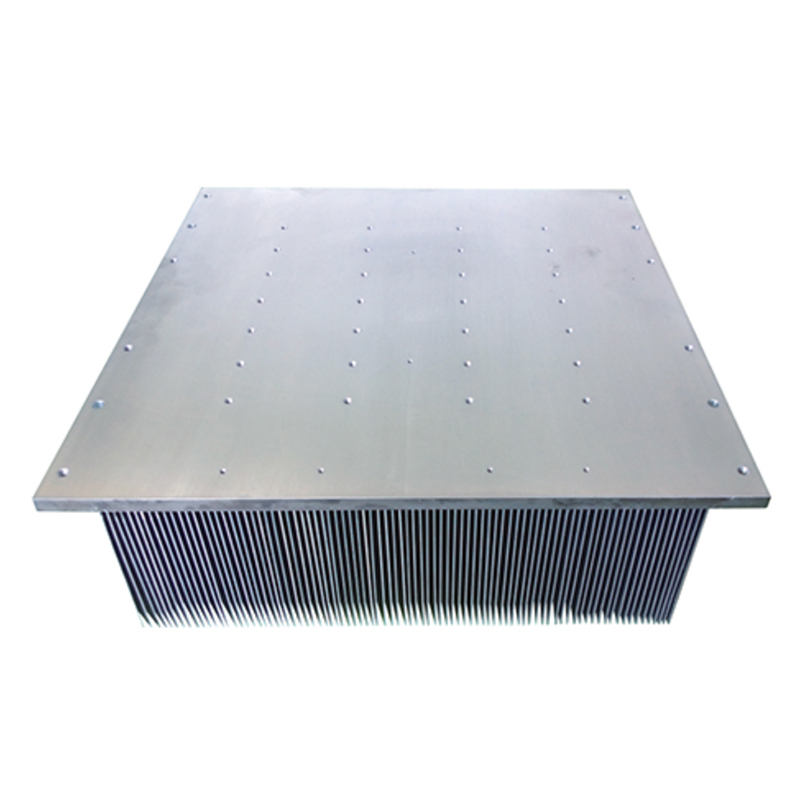
1. Thermal Challenges in LED and Laser Equipment
Optical components are exceptionally sensitive to thermal fluctuations. To maintain beam quality and luminous efficacy, thermal engineers must navigate three primary degradation mechanisms:
-
Localized Heat Flux: High-power LEDs and industrial laser diodes dissipate the majority of their electrical energy as waste heat within a microscopic semiconductor junction, creating intense localized heat flux that must be rapidly drawn away.
-
Wavelength Shift and Color Drift: For laser equipment, temperature changes cause physical thermal expansion of the semiconductor cavity, shifting the output wavelength and degrading focus. In LED arrays, “thermal droop” occurs when forward voltage drops, causing lumen output to plummet as junction temperature rises.
-
Permanent Phosphor Degradation: Prolonged high temperatures degrade phosphor coatings in white LEDs, causing permanent color shifts. Keeping components at steady low temperatures is critical to reaching 50,000+ hour lifecycles.
Engineering Rule of Thumb: For precision laser modules, junction temperature fluctuations should not exceed 2∘C during continuous operation. Exceeding this thermal budget risks immediate and irreversible optical misalignment.
2. Why Traditional Heat Sinks Fall Short
Standard thermal solutions frequently hit physical and performance roadblocks when applied to high-density optical hardware.
The Limits of Standard Extrusions
Standard extruded heat sinks are produced by pushing heated metal through a steel die. Because fin geometry is constrained by die strength, fins cannot be made ultra-thin or packed densely together. Attempting to extrude ultra-high aspect ratios generates massive hydraulic pressure that shatters steel extrusion dies.
The Thermal Barrier of Bonded Fins
To overcome extrusion density limits, engineers sometimes turn to bonded fin assemblies (where individual fins are glued or soldered into a slotted base). However, this introduces a severe bottleneck:
-
Microscopic Thermal Barrier: Bonding agents (epoxies or solder joints) create an interfacial thermal resistance layer between the base plate and the fins.
-
Localized Heat Trapping: When high-flux heat enters the base, it encounters this insulating layer, causing a thermal spike directly beneath the heat source.
If an optical heat source covers less than 20% of the total base area, bonded fin solutions should be avoided—the joint resistance will cause base temperatures to spike before heat ever reaches the fins.
Technology Comparison Matrix
| Heat Sink Type | Thermal Interface Resistance | Fin Density Potential | Structural Integrity | Best Application Profile |
|---|---|---|---|---|
| Standard Extrusion | Zero (Solid unibody) | Low to Medium | Very High | Large, lower-density power electronics |
| Bonded Fin | High (Epoxy/Solder joint) | Very High | Medium | Large cooling surfaces with distributed heat |
| Skived Fin | Zero (Solid unibody) | Very High | High (Unibody) | Compact, ultra-high heat flux LEDs & lasers |
3. How Skived Fin Technology Improves Cooling Performance
Skiving utilizes a high-precision slicing tool to shave thin slices of metal from a solid block of extruded aluminum or copper, bending them upright at precise angles to form cooling fins.
Key Advantages of Skived Fins:
- 1
Seamless Unibody Heat Transfer: Because the fins are physically part of the base block, there is zero joint resistance. Heat flows continuously from the base into the fins without passing through thermal epoxies or solders.
- 2
Ultra-Thin & Dense Geometries: Skiving achieves geometries impossible in extrusion. Fins can be crafted as thin as 0.1 mm and packed closely together, dramatically expanding total surface area within the same volumetric space.
- 3
Compact Footprint: High surface-area density allows thermal designers to shrink the overall cooling assembly size without sacrificing thermal performance.
4. Material Selection: Aluminum vs. Copper
Choosing the right raw material depends primarily on power density, overall mass restrictions, and cost targets.
Aluminum (AL6063) for Light Weight & Efficiency
With a thermal conductivity around 200 W/(m⋅K), aluminum is the industry standard for large-scale industrial LED arrays, stadium fixtures, and high-bay lighting. It offers low density (∼2.7 g/cm3), cost efficiency, and ease of secondary CNC machining, making it ideal for overhead fixtures.
Copper (C1100) for Concentrated Heat Flux
Offering a thermal conductivity near 385 W/(m⋅K), C1100 copper spreads heat laterally nearly twice as fast as aluminum. It is mandatory for ultra-concentrated heat sources, such as multi-watt laser diodes and Thermoelectric Cooler (TEC) hot sides.
Material Selection Comparison
| Property / Feature | AL6063 Aluminum | C1100 Copper |
|---|---|---|
| Thermal Conductivity | ∼200 W/(m⋅K) | ∼385 W/(m⋅K) |
| Density | ∼2.7 g/cm3 | ∼8.9 g/cm3 |
| Primary Applications | Commercial LED arrays, stadium lighting | Precision laser diodes, TEC hot sides |
| Heat Flux Threshold | Ideal for <50 W/cm2 | Required for >50 W/cm2 |
Selection Rule: When thermal load density exceeds 50 W/cm2, specify C1100 copper skived fin heat sinks to prevent severe localized hot spots beneath the diode junction.
5. Skived Fin Applications in LED Systems
High-bay LED fixtures, streetlights, and architectural floodlights demand maintenance-free operation for over 50,000 hours. Because mechanical fans fail over time, many industrial LED systems rely entirely on passive cooling (natural convection).
In IP67-rated sealed enclosures where fans cannot be used, an aluminum skived fin heat sink provides the expanded surface area required for passive heat rejection. By tuning the fin pitch specifically for natural convection, hot air rises freely through the channels via thermal buoyancy without getting trapped in boundary layers.
6. Skived Fin Applications in Laser Equipment
Laser equipment requires significantly tighter thermal tolerances than general LED lighting. To drive laser temperatures below ambient levels, surgical lasers and micro-cutting tools often mount diodes directly onto Thermoelectric Cooling (TEC) modules.
Because a TEC acts as a heat pump, its hot side generates the combined heat load of the laser plus the electrical power driven into the module.
A compact copper skived fin heat sink mounted directly to the hot side of the TEC provides the rapid lateral heat spreading and high surface area needed to reject this combined heat load continuously, ensuring sub-ambient temperature stability inside handheld medical or industrial devices.
7. Partnering with Xuyuan Precision for Custom Skived Heat Sinks
Manufacturing high-precision skived fin heat sinks requires tight control over slicing tolerances, base thickness uniformity, and surface flatness.
The Importance of Surface Flatness
For optical equipment, the interface gap between the heat sink base and the semiconductor or TEC must typically be under 0.05 mm. A raw skived base can exhibit slight micro-bowing during the cutting process. To guarantee intimate contact, Xuyuan Precision performs precision post-skiving CNC face-milling to achieve optical-grade flatness across critical mounting areas.
Complete End-to-End Manufacturing
At Xuyuan Precision, we provide fully integrated production under one roof:
-
Thermal Design Assistance: Fine-tuning fin height, thickness, and pitch for your specific forced-air or natural convection environment.
-
Precision CNC Machining: Secondary milling, drilling, counterboring, and tapping mounting holes to exact drawing tolerances.
-
Surface Finishing: Anodizing for aluminum or anti-oxidation/plating treatments for copper to protect against environmental corrosion.
Frequently Asked Questions (FAQ)
Q: 1. What exactly is a skived fin heat sink?
A skived fin heat sink is a unibody cooling device manufactured using a specialized cutting tool to slice thin layers of metal from a solid block of aluminum or copper and bend them upright. Because the fins are integral to the base, there are no bonded joints or thermal resistance barriers.
Q: 2. Why is eliminating thermal interface resistance critical for lasers?
Laser diodes generate extreme heat flux over microscopic surface areas. Bonded or glued fins insert an insulating layer that traps heat at the base. Skived fin heat sinks offer a 100% solid metal pathway, allowing heat to flow instantly into the fins without localized temperature spikes.
Q: 3. Why can’t standard extruded aluminum be used for high-power LEDs?
Standard extrusion is limited by the hydraulic pressure limits of steel dies. Attempting to extrude fins that are extremely tall and close together shatters the die. Skiving bypasses die limitations completely, enabling denser, thinner fins that dramatically increase cooling surface area within the same volumetric space.
Q: 4. When should copper be selected over aluminum?
Copper offers nearly double the thermal conductivity of aluminum, making it superior for rapidly spreading concentrated heat. Choose copper for high-flux laser diodes or TEC modules (>50 W/cm2). Choose aluminum when fixture weight, overhead mounting, and overall cost are the primary factors.
Q: 5. Do skived fin heat sinks require a fan?
Not necessarily. While high-density skived fins are frequently paired with fans in compact laser hardware, they can also be engineered with wider fin pitch for passive natural convection cooling in sealed outdoor LED streetlights and floodlights.
Q: 6. Do copper skived fin heat sinks require surface treatment?
Yes. Bare copper oxidizes when exposed to moisture and air, which can degrade appearance and thermal radiation over time. Professional manufacturers apply anti-oxidation passivations or specialized plating to ensure long-term durability in field operations.
Need Custom Thermal Solutions for Your Optical Hardware?
Whether you are developing a next-generation laser module or an industrial LED fixture, Xuyuan Precision delivers custom skived heat sink prototypes and volume production tailored to your exact thermal specifications.
Contact jason@xyjmrk.cn to review your drawings and get a competitive quotation.
Post time: Jul-23-2026


