
In modern electronic engineering, thermal management is no longer an afterthought—it is a foundational pillar of system reliability, operational efficiency, and component longevity. As microprocessors, power semiconductors, LED arrays, and telecommunication modules increase in power density while decreasing in physical footprint, the challenge of removing waste heat becomes exponentially more complex.
Standard, off-the-shelf heat sinks serve a valuable purpose in early-stage bench prototyping and low-density electronic devices. However, as product designs progress toward final manufacturing, standard catalog cooling blocks frequently hit a wall. Mechanical layout restrictions, strict volumetric limits, non-standard mounting configurations, and uncompromising thermal targets necessitate a fully tailored thermal solution.
At Xuyuan Precision, we specialize in bridging the gap between thermal simulation and physical mass production. Through custom aluminum profile extrusion, high-precision post-extrusion CNC machining, and specialized surface finishing, we engineer custom extruded aluminum heat sinks designed to match the exact physical, thermal, and mechanical demands of your proprietary hardware.
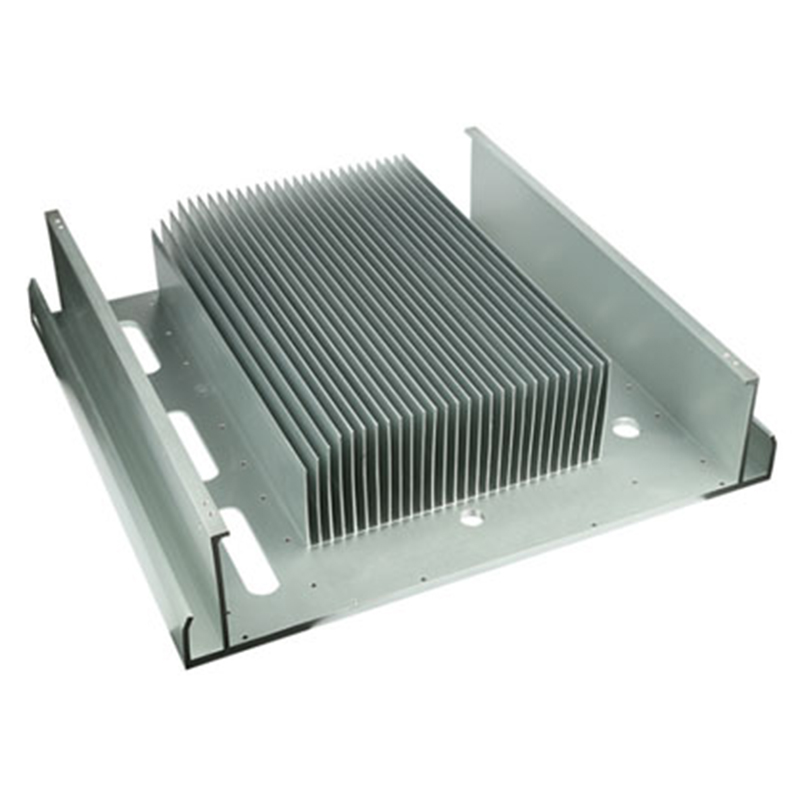
1. Understanding Custom Extruded Aluminum Heat Sinks
A custom extruded aluminum heat sink is produced by forcing heated aluminum alloy billets through a custom-machined steel die to form a continuous cross-sectional profile. This raw profile features the exact base thickness, fin height, fin spacing, and integrated structural elements required for a specific electronic application. Once extruded, the profile is cut to precise linear lengths and subjected to secondary operations such as CNC milling, drilling, tapping, deburring, and protective surface finishing.
Aluminum extrusion stands out as one of the most practical, scalable, and cost-effective heat sink manufacturing methods in modern engineering. Unlike fully CNC-machined heat sinks—which generate substantial material waste and require long machine run-times per part—extrusion shapes the basic cooling geometry in a matter of seconds during the pressing phase. This provides unparalleled consistency across high-volume production while maintaining the flexibility to adjust overall length per component without changing the primary tooling.
When Standard Heat Sinks Fall Short
Engineers often begin a design search using standard catalog parts. However, a custom extruded solution becomes essential under several common industry conditions:
- Volumetric & Physical Enclosure Limits: When an off-the-shelf heat sink interferes with nearby PCB components, enclosure walls, mounting standoffs, or internal cabling.
- Inadequate Surface Area: When catalog heat sinks do not provide sufficient fin height or fin density to dissipate the continuous thermal load without causing thermal throttling or silicon junction failure.
- Proprietary Mounting Structures: When the heat sink must double as an enclosure lid, structural chassis element, or feature specific mounting hole patterns, threaded bosses, or sliding rail tracks.
- Strict Aesthetic & Environmental Specs: When the product is consumer-facing or operates in harsh, corrosive outdoor environments requiring specialized anodizing or protective powder coatings.
- Production Cost Control: When high manufacturing volumes make modifying standard parts via manual post-drilling and cutting financially inefficient compared to custom extrusion die tooling.
2. Why Custom Extrusion Strategy Matters: Problem vs. Solution
Designing a custom extruded heat sink is about treating thermal management as an integrated system rather than an added component. The table below details common engineering bottlenecks encountered in electronics manufacturing and how custom aluminum extrusion addresses each issue directly.
| Project Constraint / Challenge | Limitations of Standard Heat Sinks | How Xuyuan Precision Custom Extrusion Solves It |
|---|---|---|
| Space Constraint inside Custom Enclosures | Fixed square/rectangular catalog dimensions force design compromises or larger enclosures. | Profiles are custom-extruded to fit exact internal spatial envelopes, bypassing internal obstacles. |
| High Heat Flux over Small Footprint | Generic fin spacing fails to maximize surface area within restricted thermal zones. | Base thickness and fin pitch are tailored precisely to spread and dissipate high local heat loads. |
| Non-Standard Mounting & Board Layouts | Requires secondary manual drilling, custom clip adapters, or risky adhesive bonding. | CNC post-processing integrates precision drilled holes, tapped threads, and PCB alignment slots. |
| Harsh Operating Environments | Standard parts offer basic finish quality that may corrode, peel, or degrade rapidly outdoors. | Custom application of clear, black, or hard anodizing and chemical conversion for outdoor durability. |
| Variable Product Line Lengths | Requires stocking multiple catalog part numbers with distinct tooling and unit costs. | A single custom profile die can be cut to multiple custom lengths for different product tiers. |
| Dual Structural & Cooling Roles | Standard blocks can rarely support structural loads or double as enclosure panels. | Profiles integrate structural ribs, mounting bosses, slide grooves, and exterior heat-dissipating fins. |
3. The Thermal Physics Behind Extruded Heat Sink Performance
An extruded aluminum heat sink acts as a passive heat exchanger, transferring energy from high-temperature semiconductor devices to the lower-temperature ambient fluid (air). The complete thermal resistance path determines the overall cooling efficiency and consists of multiple critical steps:
- Conduction from Heat Source to Base: Thermal energy generated within the semiconductor junction travels through the device package and Thermal Interface Material (TIM) into the heat sink base.
- Conduction through the Base: The aluminum base spreads heat laterally across the width and length of the heat sink to prevent localized hot spots.
- Conduction into the Fins: Heat travels vertically along the height of each extrusion fin.
- Convection into Air: Heat transfers from the extended surface area of the fins into the surrounding air stream through natural or forced convection.
Electronics cooling is a system-level problem. Heat sink geometry must be co-engineered alongside component placement, local airflow velocity, fan static pressure, and enclosure ventilation to achieve optimal thermal equilibrium.
Designing for Specific Airflow Modes
Airflow velocity is the primary driver when determining profile cross-section design. A profile optimized for forced convection with a high-pressure fan will perform poorly in a passive, natural convection setup due to air stagnation between tightly spaced fins.
| Airflow / Cooling Mode | Primary Design Priority | Extrusion Profile Design Strategy |
|---|---|---|
| Natural Convection (Passive Airflow) |
Minimizing airflow resistance; maximizing buoyancy-driven air movement. | Wider fin pitch (gap), vertical fin orientation, and thicker base to promote rapid heat spreading. |
| Low-Speed Forced Air (Quiet System Fans) |
Balancing extended surface area against system pressure drop. | Moderate fin density, smooth airflow channels, and optimized fin height-to-gap ratios. |
| High-Speed Forced Air (Server / Industrial Blower) |
Maximizing total surface area within compact volumetric limits. | High fin density, thinner fin profiles, and narrow gaps matched to high static pressure fans. |
| Enclosed Sealed Systems (IP67 / Outdoor Enclosures) |
Conductive heat spreading to external enclosure walls. | Thick contact bases, integrated mounting flanges, and external wall cooling fins. |
| Outdoor Heavy Machinery (Vibration & Dust Exposure) |
Structural robustness and resistance to particulate clogging. | Thicker fin tips, wide self-cleaning fin gaps, and high-durability hard anodized surfaces. |
4. End-to-End Workflow: From Engineering Concept to Mass Production
Successful custom extrusion requires rigorous engineering oversight long before aluminum is pushed through a die. Modifying a profile after tooling fabrication adds cost and delays delivery schedules. At Xuyuan Precision, our structured workflow ensures complete alignment between thermal targets, manufacturability, and quality standards.
Step-by-Step Production Process
- Thermal & Mechanical Requirement Review: Our engineering team reviews your heat dissipation targets (Watts), maximum junction temperature, heat source dimensions, spatial envelope, and airflow constraints.
- Profile Design & Design for Manufacturability (DFM): We create or refine the 2D cross-section and 3D CAD model. DFM evaluations ensure fin height-to-gap ratios, tongue ratios, and wall thickness transitions conform to aluminum extrusion standards.
- Extrusion Die Fabrication: Once drawings are approved, high-strength tool steel dies are precision-machined, heat-treated, and wire-EDM cut to reproduce the exact profile cross-section.
- Sample Extrusion & Pressing: Heated 6000-series aluminum billets are extruded through the die. Initial sample lengths are extruded, quenched, stretched for straightness, and heat-treated to the desired temper (e.g., T5 or T6).
- Precision CNC Post-Machining: Extruded profiles are cut to linear length and transferred to our multi-axis CNC machining centers. Key features including mounting holes, counterbores, tapped threads, slot cutouts, and high-flatness base milling are performed.
- Surface Finishing: Parts are thoroughly degreased, deburred, and subjected to anodizing, powder coating, or chemical conversion based on application specifications.
- First Article Inspection & Validation: Samples undergo CMM dimensional measurement, surface roughness testing, base flatness checks, and coating thickness validation before client approval.
- Mass Production & Quality Assurance: Following sample approval, full-scale production runs are executed under strict quality management protocols (ISO 9001).
5. Critical Design Guidelines for Profile Drawings and Extrusion Dies
Creating an extrudable profile requires an understanding of metal flow dynamics. Aluminum behaves as a non-Newtonian viscous solid during extrusion. Asymmetrical features, extreme wall thickness variations, or tall, tightly spaced fins create uneven pressure across the die face, leading to tool breakage or geometric distortion.
Profile Features Requiring Engineering Review
- Extrusion Aspect Ratio (Tongue Ratio): The ratio of fin height to the gap width between fins is critical. While standard extrusion supports aspect ratios up to 4:1 or 6:1, advanced heat sink dies can achieve up to 10:1 or higher depending on alloy selection and press capacity. Exceeding recommended ratios risks die tongue breakage.
- Base-to-Fin Thickness Ratio: An overly thick base connected to thin fins causes uneven cooling rates after extrusion, leading to thermal warping or wave distortion along the fin tips. Base-to-fin thickness transitions should remain within a manageable ratio (typically less than 3:1).
- Fin Tip Radius and Chamfers: Sharp, razorthin fin tips can tear during extrusion or become damaged during handling and post-machining. Adding a generous radius (0.5mm – 1.0mm) or chamfer to fin tips improves aluminum flow and structural durability.
- Asymmetry & Wall Thickness Consistency: Highly asymmetric profiles cause non-uniform metal flow velocity during pressing, leading to profile twisting and bowing. Symmetric features or balanced dummy channels help maintain linear straightness.
6. Material Selection: Choosing the Right Aluminum Alloy
Selecting the correct aluminum alloy balances thermal conductivity, mechanical strength, machinability, finish quality, and cost. 6000-series aluminum alloys (aluminum-magnesium-silicon) represent the industry standard for extruded heat sinks due to their excellent extrudability, good thermal properties, and structural strength.
| Aluminum Alloy & Temper | Thermal Conductivity (W/m·K) | Mechanical Strength | Machinability & Finishing | Primary Application Fits |
|---|---|---|---|---|
| 6063-T5 / T6 | ~200 – 209 | Moderate | Excellent extrudability; superb anodizing finish appearance. | Standard electronics cooling, LED lighting, power supplies, enclosed drive units. |
| 6061-T6 | ~166 – 180 | High | Excellent structural strength; ideal for heavy CNC post-machining. | Structural heat sinks, telecom base stations, military, aerospace, and outdoor power chassis. |
| 6005A-T6 | ~180 – 190 | High (Intermediate) | Higher strength than 6063 with better extrudability than 6061. | Industrial control cabinets, automotive power electronics, solar inverters. |
| Pure Copper (For Comparison) |
~385 – 400 | Low (Heavy) | Expensive, heavier, and limited extrusion capability compared to aluminum. | High-density localized heat spreaders, CPU cold plates, heat pipe assemblies. |
7. Precision CNC Post-Machining Capabilities
While profile extrusion provides the core 2D heat dissipating cross-section, secondary CNC post-machining transforms the raw extrusion into a finished assembly. At Xuyuan Precision, our facility houses high-speed CNC machining centers, precision tapping machines, and automated surface grinders.
Common Post-Extrusion Machining Operations
- Precision Cutting to Length: CNC saw cutting achieves tight linear length tolerances ($\pm0.2\text{mm}$ or tighter), providing clean, burr-free square cut ends.
- Mounting Hole Drilling & Counterboring: Creating clearance holes for PCB standoffs, transistor clips, or enclosure mounting screws.
- High-Speed Tapping & Threading: Machining blind or through-threads directly into the heat sink base or integrated screw channels for fast component installation.
- Face Milling for Thermal Surface Flatness: The base area contacting power devices (IGBTs, CPUs, MOSFETs) is precision face-milled to achieve flatness tolerances down to $0.02\text{mm} – 0.05\text{mm}$, eliminating air gaps and minimizing TIM resistance.
- Fin Cutouts & Pocketing: Selective removal of fin sections to clear tall capacitors, connectors, or inductors on the underlying PCB layout.
- Automated Deburring & Edge Finishing: Vibratory tumbling, thermal deburring, or manual edge chamfering to remove sharp metal edges, ensuring safe handling and assembly.
8. Surface Finishing Options for Custom Aluminum Heat Sinks
Surface treatments serve two major functions in thermal management: protecting the aluminum substrate from environmental corrosion and enhancing radiative heat dissipation.
Overview of Surface Finishing Choices
| Surface Treatment | Thermal Radiation Impact | Corrosion & Environmental Resistance | Electrical Properties | Ideal Application Environments |
|---|---|---|---|---|
| Clear / Natural Anodizing | Significantly increased | Good protection against indoor humidity and atmospheric oxidation. | Electrically insulating layer (non-conductive surface). | Indoor power supplies, consumer electronics, industrial controllers. |
| Black Anodizing | Maximum radiative cooling | Good protection; visually masks handling fingerprints and minor scratches. | Electrically insulating layer (non-conductive surface). | Passive natural convection heat sinks, audio amplifiers, enclosed equipment. |
| Hard Coat Anodizing (Type III) | High thermal emissivity | Exceptional corrosion, wear, and chemical resistance; thick oxide layer. | High dielectric strength insulation. | Military hardware, marine electronics, mining controls, harsh outdoor environments. |
| Chemical Conversion (Chromate/Passivation) | Slight increase over bare metal | Moderate corrosion protection; ideal primer for painting/coating. | Electrically conductive surface for grounding/EMI shielding. | Internal telecom modules, shielded electronics boxes requiring grounding. |
| Powder Coating / Painting | High emissivity | Excellent barrier against weather, salt spray, and chemicals. | Electrically insulating. | Outdoor LED luminaire housings, exposed utility power enclosures. |
9. Diversity of Industry Applications
Custom extruded aluminum heat sinks support thermal management across diverse commercial, industrial, and high-reliability sectors:
- Uninterruptible Power Supplies (UPS) & Inverters: Managing heat from high-power IGBT modules and switching transistors in renewable energy systems and industrial power conversion.
- LED Lighting Fixtures: Combining high-wattage LED array thermal management with housing aesthetics and weatherized enclosures.
- Telecommunications & 5G Infrastructure: Cooling outdoor remote radio units (RRUs), base station power modules, and optical transceivers exposed to weather conditions.
- Industrial Automation & Servo Drives: Providing passive or low-speed forced-air cooling for motor drives, PLCs, and compact cabinet-mounted controllers.
- Data Center Hardware & Networking: Delivering precise, low-pressure-drop cooling profiles for rack-mounted server hardware, switches, and power distribution units.
- Automotive & EV Infrastructure: Coolers for onboard chargers (OBC), DC-DC converters, battery management systems (BMS), and EV fast-charging stations.
10. Quality Assurance, Flatness Control, and Inspection Protocols
Thermal contact efficiency depends heavily on the surface interface between the heat-generating component and the heat sink base. Even microscopic air pockets dramatically increase interface thermal resistance . At Xuyuan Precision, our quality assurance protocols focus directly on critical thermal interface parameters.
Key Quality Control Inspection Items
- Contact Surface Flatness Testing: Base flatness is inspected using precision dial indicators, optical flats, or Coordinate Measuring Machines (CMM) to ensure adherence to strict flatness callouts ($\le0.05\text{mm}$ over $100\text{mm}$).
- Surface Roughness ($Ra$) Measurement: Contact face roughness is checked via profilometers to ensure smooth mating surfaces ($Ra \le 1.6\mu\text{m}$ or better) that maximize thermal pad contact.
- Thread & Hole Position Verification: Multi-axis CMM inspection ensures mounting hole centers and thread pitch accuracy to guarantee alignment with PCB layouts.
- Anodizing & Finish Thickness Testing: Eddy-current coating thickness gauges confirm anodize layer thickness matches chemical exposure specifications (e.g., 10$\mu\text{m}$ to 25$\mu\text{m}+$ for hard anodizing).
- Fin Straightness & Bow Inspection: Checking profile straightness, twist, and fin alignment against ISO 2768 or EN 755-9 extrusion tolerance standards.
11. RFQ Checklist: What Information to Provide for a Fast, Accurate Quote
Providing clear, comprehensive technical details during the Request for Quote (RFQ) stage eliminates guesswork, minimizes engineering revision cycles, and speeds up tooling turnaround times. Use the checklist below when submitting your custom extruded heat sink project to Xuyuan Precision:
| RFQ Parameter Category | Required Details / Documents | Why It Accelerates Your Project |
|---|---|---|
| Design Drawings | 2D vector drawings (PDF/DWG with tolerances) & 3D CAD models (.STEP/.IGS). | Allows instant DFM review, die feasibility checking, and CNC program planning. |
| Thermal Metrics | Power loss (Watts), max operating temp ($T_j$), ambient temp ($T_a$). | Enables validation of base thickness, fin height, and surface area ratios. |
| Airflow Conditions | Natural convection orientation, or fan CFM, air speed, and flow direction. | Guides fin spacing optimization (wide vs. dense fin field). |
| Material & Temper | Alloy preference (e.g., 6063-T5, 6061-T6) or performance priorities. | Determines material sourcing, extrusion pressure needs, and post-machining speeds. |
| Surface Finish | Type of finish (clear/black anodize, chromate, raw) & thickness specs. | Clarifies plating mask needs, dimension tolerances, and finishing costs. |
| Critical Tolerances | Base flatness callouts, hole position tolerances, surface roughness ($Ra$). | Identifies required post-extrusion machining steps vs. standard extrusion tolerances. |
| Production Quantity | Prototype sample requirement & estimated annual production volume (EAV). | Helps optimize tooling choice (single-cavity vs. multi-cavity extrusion dies). |
Partner with Xuyuan Precision for Custom Thermal Engineering
At Xuyuan Precision, we deliver custom aluminum extrusion heat sinks designed for long-term thermal reliability. From initial concept and extrusion feasibility reviews to multi-axis CNC machining, anodizing, and final quality inspection, our engineering team manages every step of your production process.
Ready to optimize your electronics cooling performance? Contact the technical sales team at jason@xyjmrk.cn to submit your drawings and receive a detailed manufacturability review and competitive quotation.
Post time: Aug-13-2026


