
In the world of high-power electronics, finding the sweet spot between thermal performance, manufacturing cost, and system weight is a constant challenge. When standard extruded heat sinks cannot handle high heat fluxes, engineers often turn to skived fin heat sinks.
Because skived fins are sliced directly from a solid metal block, they offer high fin density, thin profiles, and—most importantly—zero thermal interface resistance between the base and the fins.
However, once you decide on a skived design, you face a critical engineering decision: Should you use copper or aluminum?
At Xuyuan Precision, we specialize in high-precision thermal management. In this guide, we will compare copper and aluminum skived heat sinks from both technical and procurement standpoints to help you make the right choice for your next project.
1 The Skiving Process: A Quick Overview
Before diving into materials, it is helpful to understand the skiving process. Skiving uses a specialized cutting tool to shave and lift thin, vertical fins from a solid bar of metal.
Because the fins and the base remain part of the same continuous piece of metal, there is no thermal barrier (such as solder or epoxy) at the joint. This makes skiving highly efficient for demanding thermal applications like telecommunications, AI servers, LED modules, lasers, and industrial power supplies.
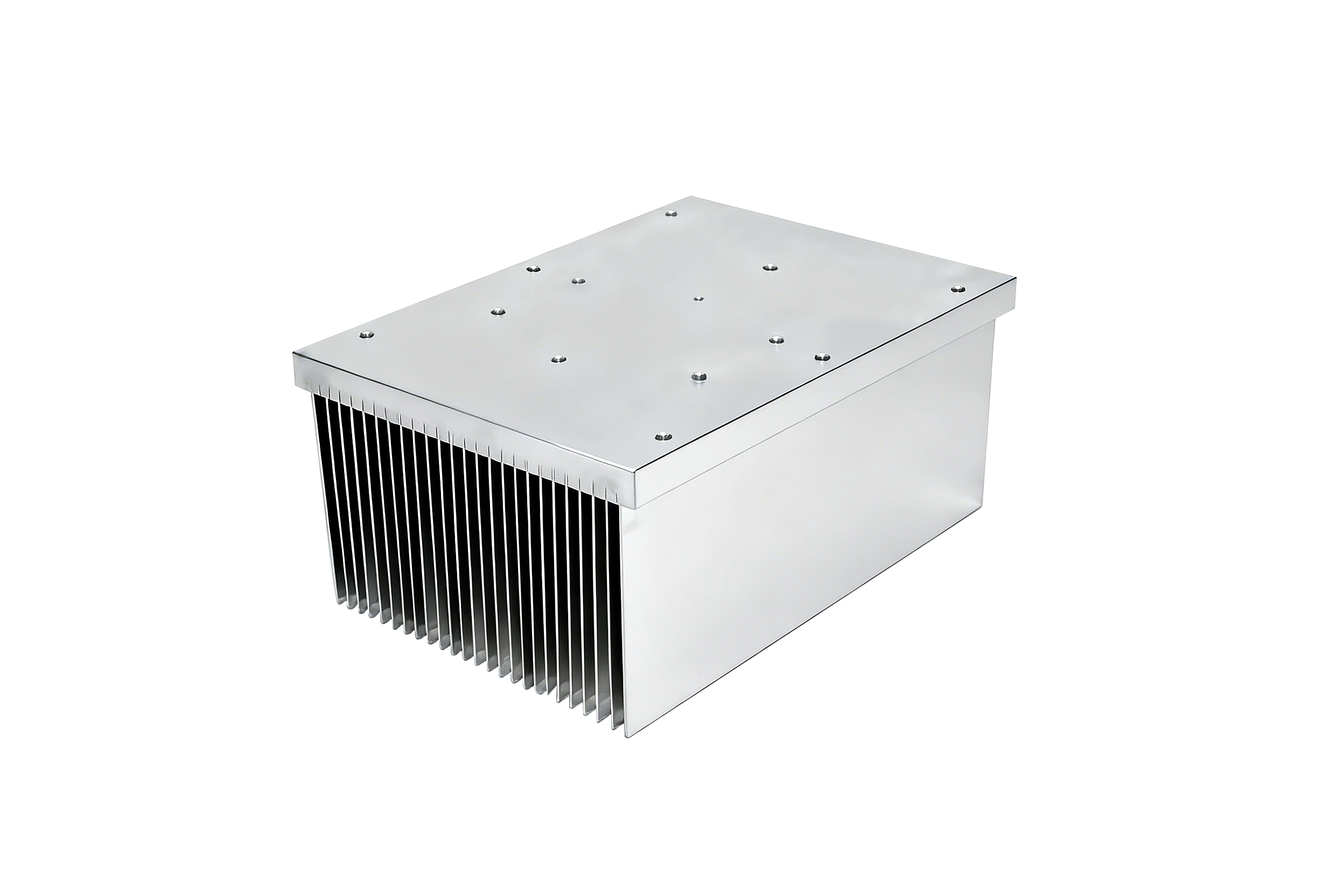
Copper vs. Aluminum: Head-to-Head Comparison
While copper is a superior conductor of heat on paper, thermal design in real-world systems is rarely that simple. Below is a quick comparison of how the two metals perform in skived configurations:
| Feature | Copper Skived Heat Sink | Aluminum Skived Heat Sink |
|---|---|---|
| Thermal Conductivity | Extremely High (≈400 W/m⋅K) | Good (≈200 W/m⋅K) |
| Heat Spreading | Exceptional for localized hot spots | Suitable for moderate or distributed heat |
| Weight | Heavy (High density: ≈8.96 g/cm3) | Light (Low density: ≈2.70 g/cm3) |
| Material & Production Cost | Higher | Lower & more cost-effective |
| Surface Treatment | Anti-oxidation coating, nickel plating | Anodizing, chromating |
| Ideal For | High heat flux, tight spaces, lasers | Telecom, servers, general industrial modules |
When to Choose Copper: High Heat Flux and Hot Spots
Copper’s primary advantage is its exceptional thermal conductivity. It is twice as effective as aluminum at moving heat.
However, copper is most useful when the thermal bottleneck of your system is lateral heat spreading at the base. This is common when:
- • The heat source is highly concentrated or compact (e.g., laser diodes, high-performance CPUs/GPUs).
- • The overall physical space for the heat sink footprint is extremely limited.
- • You need to lower the peak junction temperature of highly sensitive components under continuous load.
Engineering Tip: If your heat source is small and intense, a copper base will rapidly draw heat away from the contact area and distribute it across the skived fin field. An aluminum base might cause heat to bottle up directly above the chip, leading to localized overheating.
When to Choose Aluminum: The Practical, Balanced King
For the majority of electronics cooling applications, aluminum is the most practical choice. It offers an ideal compromise of thermal capability, weight control, and production economics.
Aluminum skived heat sinks are preferred when:
- ✓ Weight is a strict constraint: For mobile devices, aerospace applications, vehicle electronics, or PCB-mounted components, the mass of copper can cause mechanical failure, vibration risks, or shipping cost spikes.
- ✓ Cost efficiency is critical: Aluminum raw materials are significantly cheaper than copper, and the machining process is less demanding on tools, lowering the cost per unit in batch production.
- ✓ The heat load is distributed: If your heat sources are spread out across a larger area, aluminum can easily dissipate the heat when paired with an optimized fin design and adequate airflow.
The Role of Airflow: The Great Equalizer
A common pitfall in thermal procurement is assuming a copper heat sink will automatically solve a cooling issue.
Heat sinks work in two stages:
- Conduction: Heat moves from the source through the metal body (where copper excels).
- Convection: Heat moves from the metal fins into the surrounding air.
If your system has poor airflow or natural convection, the bottleneck is on the air side, not the metal side. In low-airflow environments, a copper heat sink will heat up and store thermal energy, but it cannot release it to the air any faster than an aluminum heat sink with the same surface geometry.
Before committing to the high cost of copper, confirm that your system’s fan and airflow design are sufficient to utilize the extra thermal conductivity.
The Hybrid Alternative: The Best of Both Worlds
If you have a highly concentrated hot spot but are limited by weight or budget, you do not have to choose strictly between full copper and full aluminum. At Xuyuan Precision, we often recommend hybrid thermal designs:
- Copper-Clad Aluminum / Copper Inserts: Press-fitting or soldering a copper block into the aluminum base directly underneath the heat source. This spreads the heat locally, while lightweight aluminum fins handle the convective dissipation.
- Vapor Chamber / Heat Pipe Integration: Embedding vapor chambers or heat pipes inside an aluminum skived heat sink to supercharge the base spreading performance without the weight penalty of solid copper.
Quality Inspection and Process Controls
Whether you choose copper or aluminum, skived fin heat sinks require strict manufacturing process controls. At Xuyuan Precision, our quality assurance protocols focus on the following critical points:
Base Flatness: High-performance cooling requires perfect thermal contact. We post-machine the contact surface of our skived heat sinks to achieve excellent flatness tolerances.
Fin Consistency and Alignment: We inspect the thickness and spacing of the skived fins to prevent airflow blockages and maintain consistent boundary layer conditions.
Surface Protection: To prevent environmental degradation, we offer professional surface treatments—such as anodizing for aluminum and anti-oxidation coatings or nickel plating for copper.
RFQ Checklist: What Buyers Should Prepare
To help our engineering team design and quote the most cost-effective skived fin solution for your project, please prepare the following specifications for your inquiry:
- Thermal Requirements: Total heat load (W), dimensions of the heat source, and target maximum temperature.
- Environmental Factors: Airflow velocity (LFM or CFM) and maximum ambient operating temperature.
- Mechanical Specifications: Maximum physical envelope (L x W x H) and maximum allowable weight.
- Material Preferences: Your preference for Copper, Aluminum, or a Hybrid design.
- Volume & Compliance: Prototype quantity, annual production volume, and required surface finishes or certifications.
Partner with Xuyuan Precision
At Xuyuan Precision, we understand that thermal management is never a one-size-fits-all equation. Our engineering team is ready to analyze your drawings, calculate thermal loads, and recommend the optimal skived heat sink design to fit your technical and commercial goals.
Ready to start your custom heat sink project?
Consult with our thermal engineers and receive a detailed, cost-effective quote.
Post time: Jul-17-2026


