
Liquid cold plates are highly efficient active thermal management components designed to transfer extreme waste heat from critical electronic components to a circulating fluid coolant when traditional forced air cooling fails under high heat flux conditions. Choosing the optimal liquid cold plate category—Embedded Tube, Monolithic, or Assembled—depends directly on your thermal dissipation targets, mechanical packaging boundaries, coolant compatibility, and overall budget.
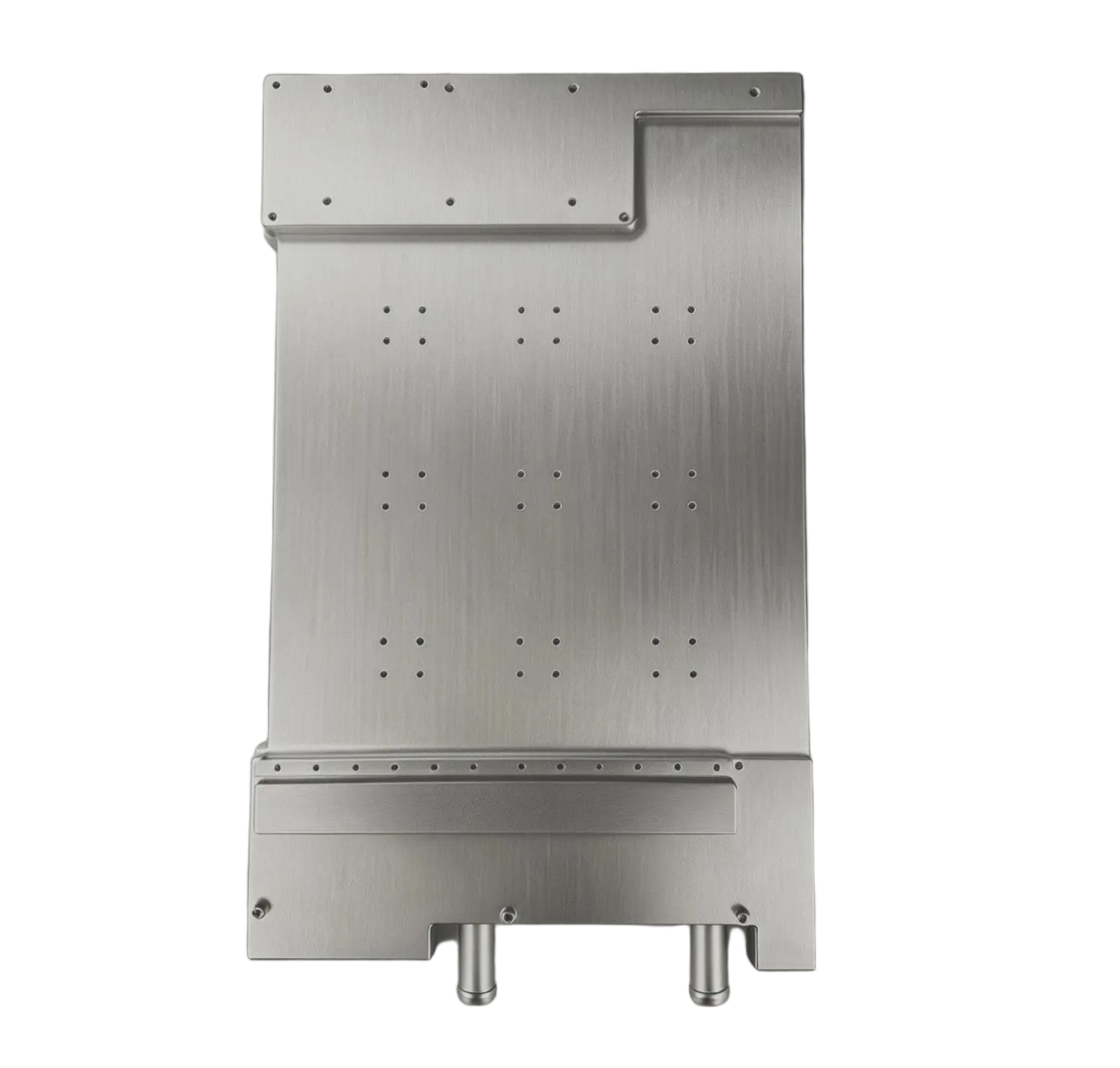
1. Overview of Cold Plate Design Categories
Liquid cold plate designs are primarily categorized by their internal fluid routing structures and manufacturing processes. Each classification offers unique structural, thermal, and cost trade-offs.
| Design Category | Manufacturing Method | Typical Heat Load | Key Advantage |
|---|---|---|---|
| Embedded Tube | Tubes pressed or soldered into base plate grooves | Moderate | Cost-effective, simple manufacturing |
| Monolithic | Friction Stir Welding (FSW), Vacuum Brazing, Deep Drilling | High to Very High | Superior thermal performance, robust single structure |
| Assembled | Mechanical fasteners, epoxy bonding, O-ring seals | Low to Moderate | High design flexibility, low initial tooling costs |
2. Embedded Tube Cold Plates
Embedded tube cold plates integrate fluid-carrying conduits directly into a pre-grooved base plate using tight mechanical press fits or soldering techniques. This foundational construction offers a straightforward thermal path and cost-effective manufacturing for moderate thermal loads, such as power supply units, solar inverters, and motor drive IGBT modules.
Tube Material Selection: Copper vs. Stainless Steel
| Feature | Copper Tubes | Stainless Steel Tubes |
|---|---|---|
| Thermal Conductivity | Excellent (~400 W/m·K) | Good (~15–20 W/m·K) |
| Corrosion Resistance | Good, but susceptible to specific coolants | Excellent; ideal for aggressive or sterile fluids |
| Relative Cost | Generally lower | Higher material & machining costs |
- Interface Contact Quality: Heat transfer relies on minimizing thermal resistance at the tube-to-base joint via tight fits or solder interface layers.
- Base Plate Heat Spreading: The base material spreads heat from localized high-heat sources across the tube surface area.
- Fluid Flow Rates: Higher flow velocities increase internal convective heat transfer coefficients.
3. Monolithic Cold Plate Technologies
Monolithic liquid cold plates consolidate internal fluid passages into a unified, solid structure. By eliminating mechanical thermal resistance at internal interfaces, monolithic designs handle extreme heat flux and demanding environmental stress.
|
Friction Stir Welded (FSW)
FSW utilizes solid-state friction welding to join aluminum plates without melting the metal. This yields a fine-grained, high-strength bond with zero filler metal contamination and minimal thermal distortion. Ideal for EV battery packs, high-performance computing clusters, and aerospace systems. |
Deep Drilled Cold Plates
Manufactured by precision-drilling fluid channels directly into a solid copper or aluminum block. With zero internal joint failure points, deep drilled plates offer extreme internal pressure resistance and long-term reliability in defense, medical diagnostic tools, and semiconductor machinery. |
Vacuum Brazed and Advanced Welded Cold Plates
Vacuum brazing joins complex internal fin structures and outer plates inside a vacuum furnace, eliminating air gaps and maximizing internal surface area for heat transfer. Advanced welding fuses base metals directly, delivering maximum structural integrity for extreme thermal and pressure environments.
4. Assembled Cold Plates
Assembled cold plates utilize mechanical fasteners (bolts/screws), epoxy adhesives, or elastomeric O-rings to join separate structural components. This modular approach provides maximum design agility for lower volumes or rapidly evolving prototype iterations.
| Technology | Low Volume Cost | High Volume Cost | Design Flexibility |
|---|---|---|---|
| Assembled | Low | Medium | High |
| Embedded Tube | Low | Low | Medium |
| Deep Drilled | Medium | Medium | High |
| FSW | Medium | Low | Medium |
| Vacuum Brazed / Welded | High | Medium | High |
5. Cold Plate Selection Decision Matrix
| Evaluation Factor | Embedded Tube | FSW | Deep Drilled | Vacuum Brazed | Assembled |
|---|---|---|---|---|---|
| Heat Flux Capacity | Moderate | High | Very High | High | Low–Moderate |
| Pressure Drop | Low–Moderate | Low–Moderate | Low–Moderate | Low–Moderate | Low–Moderate |
| Unit Cost | Low | Medium | Medium–High | High | Low |
| System Reliability | Good | Excellent | Excellent | Excellent | Good |
| Manufacturing Complexity | Low | Medium | High | High | Low–Medium |
| Customization Level | Medium | Medium | High | High | High |
6. Partnering with Xuyuan Precision for Custom Cold Plates
Executing a reliable liquid cooling system requires exact engineering and precision manufacturing capabilities. Xuyuan Precision offers complete turn-key thermal management engineering services—from initial thermal concept and CFD fluid flow simulation to prototype fabrication, helium leak testing, and mass production.
Our 4-Step OEM Collaboration Process:
- Submit Project Design: Share your thermal requirements, CAD files, and mechanical boundary conditions with our engineering team.
- Design & Simulation Analysis: Receive engineering feedback, pressure drop evaluations, and custom flow path proposals.
- Engineering Support: Work directly with our thermal R&D team to optimize material selection and manufacturing pathways.
- Precision Manufacturing & Global Delivery: Full-scale production utilizing precision CNC machining, advanced joining technologies, leak testing, and global delivery.
Post time: Aug-07-2026


