
In modern industrial thermal management, power electronics, laser systems, and high-frequency communication modules generate intense localized heat. While air cooling hits physical barriers, liquid cooling offers a highly effective alternative. However, thermal engineers often face a tough tradeoff: expensive, highly complex machined cold plates versus oversimplified cooling blocks that underperform.
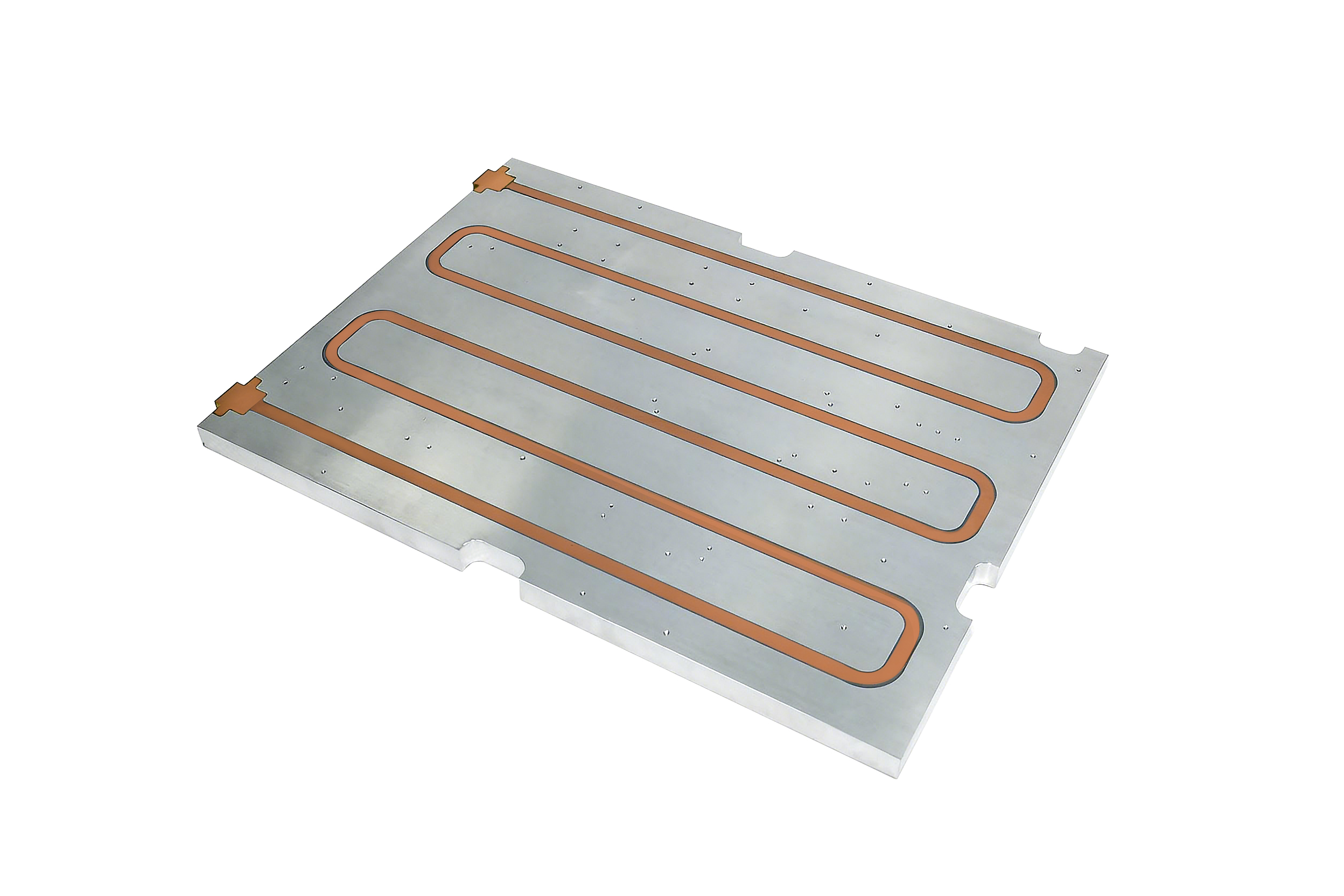
What Is an Embedded Tube Cold Plate?
An embedded tube cold plate consists of a high-conductivity metal base plate engineered with pre-routed surface grooves, into which a seamless metal tube is mechanically pressed or bonded. The base plate acts as a structural mounting platform and broad heat spreader, while the inner tube conducts the liquid coolant directly beneath critical hot spots.
This design separates two key thermal functions: mechanical heat spreading (handled by the base plate) and fluid containment (handled entirely within the continuous tube). Because fluid never directly contacts the aluminum base, corrosion risk is minimized, and external seam seals are eliminated.
An embedded tube cold plate assembly includes several essential components:
| Component | Primary Design Function | Engineering Impact |
|---|---|---|
| Base Plate | Provides structural rigidity and initial heat spreading. | Usually machined from Aluminum 6061/6063 for optimal weight-to-cost ratio. |
| Embedded Tube | Directs coolant through the designated flow path. | Continuous copper or stainless steel prevents internal joint leaks. |
| Machined Groove | Houses and supports the formed tube. | Precision geometry maximizes direct contact area between tube and base. |
| Thermal Bonding Layer | Fills micro-air gaps at the interface. | High-conductivity thermal epoxy or mechanical press-fitting lowers thermal resistance. |
| Inlet/Outlet Ports | Connects to the system’s liquid loop. | Custom fittings (NPT, barbed, threaded, or quick-disconnect) eliminate external adapters. |
The Cost Logic Behind Embedded Tube Cold Plates
The core advantage of an embedded tube design lies in value engineering. Fully machined cold plates require intricate internal channel milling, followed by complex vacuum brazing or friction stir welding (FSW) to seal the cooling chamber. Embedded tube cold plates eliminate these costly steps.
Cost Comparison Matrix
| Cost Factor | Embedded Tube Cold Plate | Fully Machined / Brazed Cold Plate |
|---|---|---|
| Machining Time | Low to Medium: Open groove surface milling. | High: Deep internal pocketing and micro-channel cutting. |
| Sealing & Leak Risk | Extremely Low: Continuous seamless tube route. | Medium to High: Requires multi-axis brazing/welding seals. |
| Process Complexity | Simplified: Bending, embedding, surface fly-cutting. | High: Vacuum brazing, post-weld stress relief, planar grinding. |
| Prototype Iteration | Fast: Easy tube re-bending and groove adjustment. | Slow: Requires redesigning internal cores and brazing fixtures. |
| Overall Unit Cost | Highly Economical for mid-to-high volume production. | Premium Pricing driven by multi-stage processing. |
By using an embedded tube architecture, Xuyuan Precision helps buyers trim unnecessary manufacturing expense while delivering targeted liquid cooling performance.
Material Strategy: Copper Tube + Aluminum Base
Material selection drives both cooling capability and manufacturing economy. The combination of a copper tube press-fit into an aluminum base plate is one of the most practical thermal solutions available:
- Copper Tube Performance: Copper offers exceptional thermal conductivity (~390 W/m·K), rapidly drawing heat out of the base plate and into the flowing coolant.
- Aluminum Base Efficiency: Aluminum (160–200 W/m·K) provides strong structural integrity and lateral heat spreading at roughly one-third the weight and density of pure copper.
- Corrosion Control: Deionized water or water-glycol mixtures (EGW/PGW) flow exclusively through the copper tube, keeping corrosive fluid off raw aluminum and simplifying fluid chemistry management.
Tube Routing & Engineering Considerations
Because the coolant path follows the bent tube, thermal performance depends heavily on intelligent tube routing. A poorly routed tube can leave high-heat zones uncooled, regardless of fluid flow rate.
At Xuyuan Precision, our engineering team optimizes tube geometry using several practical guidelines:
- Heat Source Mapping: Tubes are routed directly beneath primary heat generators (such as IGBT modules, MOSFETs, or laser diodes) to minimize conductial resistance.
- Bend Radius Control: Overly tight bends constrict inner tube walls, creating high hydraulic resistance and unnecessary pump strain. We maintain generous bend radii to keep flow uniform.
- Groove Profile & Mechanical Interface: Grooves are machined to precise depth tolerances. The tube is press-fit with thermal bonding agents to yield flat, void-free contact surfaces across the entire interface.
- Balanced Hydraulic Resistance: Tube diameter and total path length are calculated to balance pressure drop with required flow rates for optimum convective heat transfer.
Target Applications
Embedded tube cold plates are ideal for distributed heat loads, moderate power densities, and cost-sensitive projects requiring high operational reliability:
- Industrial Power Supplies & Inverters: Cools high-power switches and transformers in compact electrical cabinets.
- Laser & Optical Systems: Provides precise temperature control and eliminates fluid contact with sensitive optics enclosures.
- Medical Diagnostic Devices: Delivers ultra-reliable, leak-free cooling for MRI power supplies, X-ray tubes, and diagnostic electronics.
- Telecom & RF Transceivers: Cools high-frequency base station amplifiers with repeatable thermal performance.
- Battery Energy Storage Systems (BESS): Cools power conversion hardware across large-scale renewable energy installations.
Quality Control Standards at Xuyuan Precision
A cooling plate failure can compromise an entire electronic system. That is why Xuyuan Precision applies rigorous quality checks throughout production:
- Tube Bending & Ovality Checks: We monitor inner tube wall cross-sections during bending to prevent flow restrictions.
- Precision Fly-Cutting: Post-embedding surface machining ensures high surface flatness (≤0.05 mm) for direct component mounting.
- Helium & Pressure Leak Testing: Every unit undergoes high-pressure nitrogen submerged testing or helium leak detection to verify 100% seal integrity before shipment.
- Flow Rate & Pressure Drop Validation: Hydraulic testing confirms the thermal loop matches design calculations.
Embedded Tube vs. Alternative Cold Plate Technologies
Choosing the right cold plate technology depends entirely on your specific heat flux, thermal layout, and budget parameters:
| Cold Plate Type | Best Used For | Key Characteristic |
|---|---|---|
| Embedded Tube Cold Plate | Distributed heat sources, cost-sensitive designs, low leak tolerance. | Formed continuous metal tube embedded in a machined plate. |
| CNC Machined Cold Plate | High heat flux concentrated in small areas; intricate flow channels needed. | Open channels milled directly into base and sealed with a cover plate. |
| Vacuum Brazed Cold Plate | Extreme power densities, internal pin-fin arrays, compact spaces. | Multi-layer aluminum structures fused together in a vacuum furnace. |
| FSW Cold Plate | High-strength structural integration using aluminum alloys. | Friction stir welding seals surface plates over internal flow paths. |
Request a Custom Cold Plate Quote from Xuyuan Precision
Whether you are designing a new liquid cooling loop or seeking to cost-optimize an existing thermal system, Xuyuan Precision offers complete design-for-manufacturability support, rapid prototyping, and scalable volume production.
Send us your project specifications:
- Cold Plate CAD file
- Coolant type (EGW, PGW, Deionized Water) and target flow rate
- Maximum allowable pressure drop and target interface temperature
- Overall footprint, mounting hole layout, and preferred port connections
Contact jason@xyjmrk.cn to receive a detailed thermal evaluation and manufacturing quotation for your custom embedded tube cold plate project.
Post time: Aug-11-2026


