
If you are budgeting a new thermal management program, asking “What is the average price of a liquid cold plate?” is like asking “How much does a vehicle cost?” The answer depends entirely on whether you are building a commercial utility truck or a high-performance aerospace engine.
In thermal management, a liquid cold plate is rarely sold as an off-the-shelf commodity. It is an explicitly engineered thermal interface. For a simple extruded aluminum plate manufactured in high-volume production, the unit cost can fall into the low tens of dollars. Conversely, for a complex, vacuum-brazed or friction-stir-welded (FSW) copper cold plate built for high-power-density applications, the unit cost often reaches several hundred dollars.
At Xuyuan Precision, we routinely help engineering and procurement teams navigate this trade-off. The real objective is never just finding the cheapest plate; it is identifying the exact combination of material, process, and specification that satisfies your thermal load at the lowest total cost of ownership (TCO).
In this comprehensive guide, we unpack the primary pricing drivers, manufacturing trade-offs, common cost-inflating pitfalls, and actionable strategies to optimize your next cold plate quote.
Why Liquid Cold Plate Pricing Varies So Dramatically
Unlike standard fasteners or stamped passive heatsinks, liquid cold plates feature intricate internal geometries, custom fluid flow paths, tight sealing mechanisms, and specialized surface interfaces.
Two cold plates that look identical from the outside can differ in cost by 5x to 10x. Why? Because underneath the hood, one might feature a simple drilled aluminum passage, while the other utilizes microchannel pins vacuum-brazed to a custom copper core.
Procurement teams that treat cold plates as off-the-shelf hardware frequently encounter budget overruns and unexpected lead-time delays. To avoid these traps, you need to understand the main cost levers.
The 7 Core Drivers of Liquid Cold Plate Cost
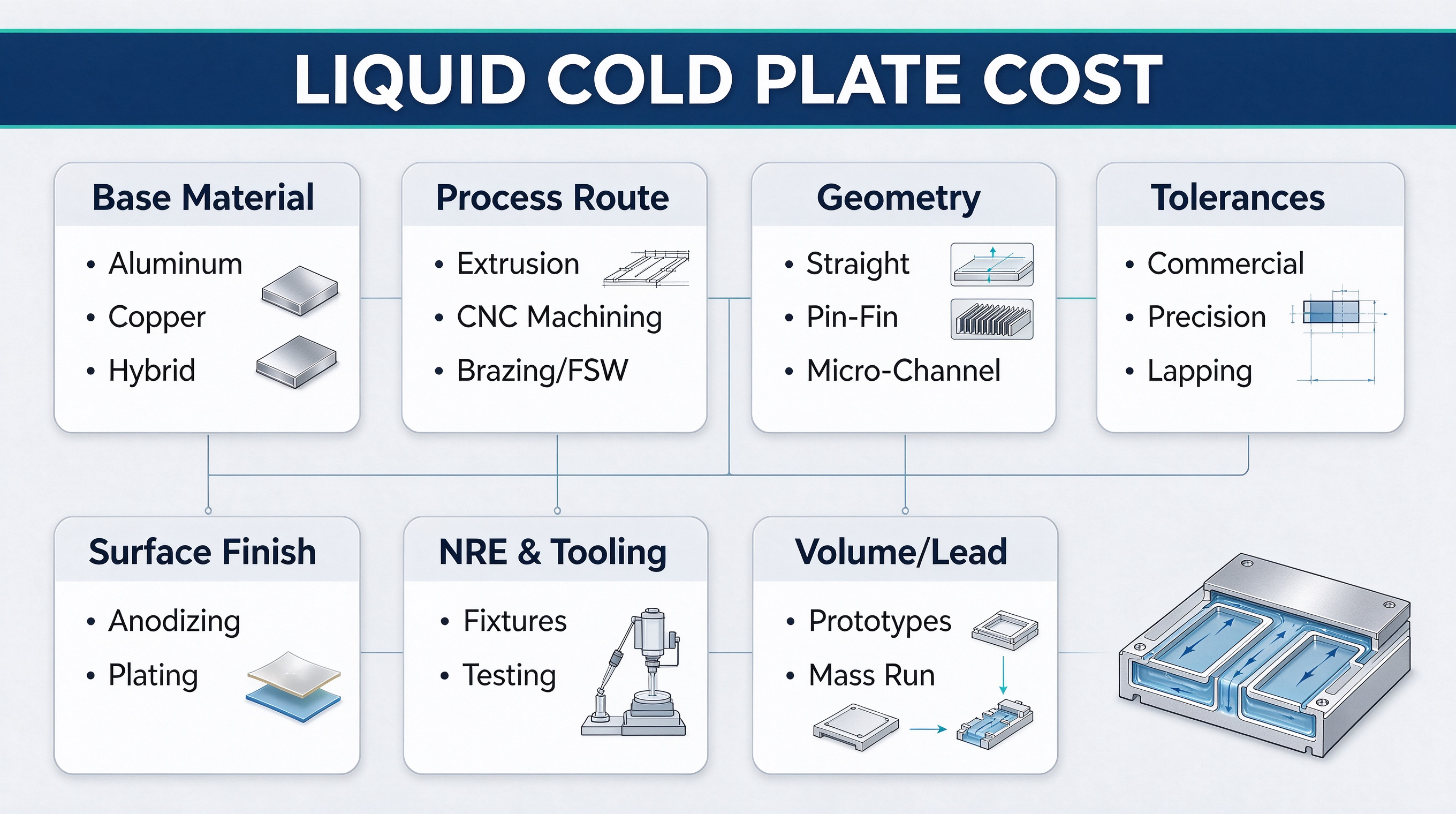
1. Base Material Selection: Aluminum vs. Copper
Material selection is the first and often most impactful lever available to design engineers.
- Aluminum (e.g., 6061 / 6063): Lightweight, highly cost-effective, and easy to machine. Aluminum provides sufficient thermal performance for the vast majority of industrial, automotive, and power electronics applications.
- Copper: Offers roughly 1.8× to 2× the thermal conductivity of aluminum. It is indispensable for high-heat-flux environments. Raw copper costs roughly 2x to 3x more per kilogram than aluminum.
Xuyuan Engineering Tip: If your heat source is concentrated in a small area, consider a hybrid architecture—an aluminum cold plate body integrated with a targeted copper local insert directly under the hot spot.
2. Manufacturing Process & Joining Techniques
- Extrusion: Lowest unit cost.
- Embedded Tube: Cost-effective for moderate performance.
- CNC Machining: Unmatched design flexibility for low-to-mid volumes.
- Vacuum Brazing: Enables serpentine paths and zero-leak integrity (Medium–High cost).
- Friction Stir Welding (FSW): High structural integrity for high-power density.
3. Internal Geometry & Flow Path Complexity
The geometry inside the fluid cavity controls thermal resistance and pressure drop. Pin-Fin structures and microchannels significantly increase heat dissipation but require specialized machining which multiplies cycle times and quality inspection steps.
4. Plate Dimensions, Flatness, and Machining Tolerances
Larger plates consume more raw stock. More importantly, tolerances drive price non-linearly. Ultra-tight flatness requirements require multiple finishing passes and 100% CMM inspection, rapidly driving up cost.
5. Surface Treatments and Finishing
Surface finishing protects against corrosion. Options include Anodizing, Electroless Nickel Plating, and Chromate Conversion. Each adds handling and compliance costs.
6. Tooling, NRE, and Prototyping Costs
Non-Recurring Engineering (NRE) includes fixture design and programming. For a prototype run, NRE can represent 70% of the invoice; for mass production, it amortizes to pennies.
7. Order Volume & Production Lead Times
High-volume manufacturing allows suppliers to optimize tool paths and secure bulk pricing. Expedited requests incur premium surcharges.
At-a-Glance: Cold Plate Cost Drivers Matrix
| Cost Factor | Lower-Cost | Higher-Cost |
|---|---|---|
| Base Material | Aluminum | Copper |
| Process Route | Extrusion | Vacuum Brazing |
| Geometry | Simple Channels | Microchannels |
| Tolerances | Standard | Tight Flatness |
5 Common Design Mistakes
- Over-specifying Material: Using copper when aluminum suffices.
- Unnecessarily Tight Tolerances: Demanding aerospace specs on non-critical surfaces.
- Ignoring DFM: Designing channels that require non-standard tools.
- Late-Stage Revisions: Changing designs after tooling is cut.
- Prototype/Production Mismatch: Validating designs that can’t scale to mass production.
How to Get a Quote
To receive an accurate quote from Xuyuan Precision, please provide:
- Thermal Requirements (W/kW, Temp)
- Fluid Parameters (Type, Flow rate, Pressure drop)
- Mechanical Dimensions (CAD files)
- Volume & Timeline
Ready to Optimize?
Post time: Sep-29-2026


